|
|
|
www.perlite.org - The Perlite Institute Web Site
minerals.usgs.gov
www.norcalperlite.com
norcalperlite.com/contact/the-mine/
www.schundler.com
www.silbrico.com
www.incon-corp.com
www.otavi.de
www.knauf-performance-materials.com
www.perlite.dk
www.europerl.com
www.pullrhenen.nl
|
The goal of this web site is to offer information about what perlite is and its many and varied applications as well offer links to other perlite resources on the Internet. You can find out more information about perlite by clicking on the respective links of the various perlite resources listed at the left of this page.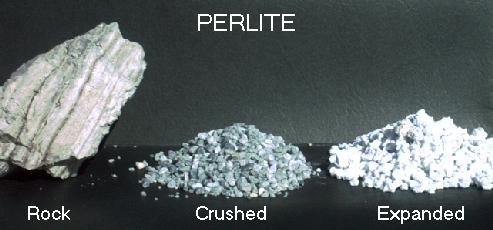
These web pages are living documents, subject to change over time. Please check back often! You can e-mail us with questions
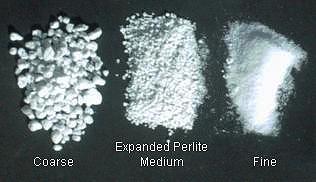
at info@perlite.net Basic facts about perlitePerlite is not a trade name but a generic term for naturally occurring siliceous rock. The distinguishing feature which sets perlite apart from other volcanic glasses is that when heated to a suitable point in its softening range, it expands from four to twenty times its original volume. This expansion is due to the
presence of two to six percent combined water in the crude
perlite rock. When quickly heated to above 1600 degrees F (871
degrees C), the crude rock pops in a manner similar to popcorn as
the combined water vaporizes and creates countless tiny bubbles
which account for the amazing light weight and other exceptional
physical properties of expanded perlite.
This expansion process also creates one of perlite's most distinguishing characteristics: its white color. While the crude rock may range from transparent light gray to glossy black, the color of expanded perlite ranges from snowy white to grayish white. Expanded perlite can be manufactured to weigh as little as 2 pounds per cubic foot making it adaptable for numerous applications. Since perlite is a form of natural glass, it is classified as chemically inert and has a pH of approximately 7. Perlite is mined and expanded all over the world. The United States is estimated to be the largest consumer and producer of crude and expanded perlite. However, there is very strong world wide production and consumption of perlite. Other leading countries producing perlite include China, Greece, Japan, Hungary, Armenia, Italy, Mexico, Philippines, and Turkey.
Uses for Perlite...There are many uses for perlite. These uses can be broken down into three general categories: construction applications, horticultural applications, and industrial applications. Construction ApplicationsBecause of perlite's outstanding insulating characteristics and light weight, it is widely used as a loose-fill insulation in masonry construction. In this application, free-flowing perlite loose-fill masonry insulation is poured into the cavities of concrete block where it completely fills all cores, crevices, mortar areas and ear holes. In addition to providing thermal insulation, perlite enhances fire ratings, reduces noise transmission and it is rot, vermin and termite resistant. Perlite is also ideal for insulating low temperature and cryogenic vessels. When perlite is used as an aggregate in concrete, a lightweight, fire resistant, insulating concrete is produced that is ideal for roof decks and other applications. Perlite can also be used as an aggregate in Portland cement and gypsum plasters for exterior applications and for the fire protection of beams and columns. Other construction applications include under-floor insulation, chimney linings, paint texturing, gypsum boards, ceiling tiles, and roof insulation boards. Horticultural ApplicationsIn horticultural applications, perlite is used throughout the world as a component of soilless growing mixes where it provides aeration and optimum moisture retention for superior plant growth. For rooting cuttings, 100% perlite is used. Studies have shown that outstanding yields are achieved with perlite hydroponic systems. Other benefits of horticultural perlite are its neutral pH and the fact that it is sterile and weed-free. In addition, its light weight makes it ideal for use in container growing. Other horticultural applications for perlite are as a carrier for fertilizer, herbicides and pesticides and for pelletizing seed. Horticultural perlite is as useful to the home gardener as it is to the commercial grower. It is used with equal success in greenhouse growing, landscaping applications and in the home in house plants. Industrial ApplicationsIndustrial applications for perlite are the most diverse, ranging from high performance fillers for plastics to cements for petroleum, water and geothermal wells. Other applications include its use as a filter media for pharmaceuticals, food products, chemicals and water for municipal systems and swimming pools. Additional applications include its use as an abrasive in soaps, cleaners, and polishes; and a variety of foundry applications utilizing perlite's insulating properties and high heat resistance. This same heat reistant property is taken advantage of when perlite is used in the manufacture of refractory bricks, mortars, and pipe insulation. | ||||||||||||||||||||||||||||||||||||||||||||||||||||